


Please Leave Us A Message
Privacy statement: Your privacy is very important to Us. Our company promises not to disclose your personal information to any external company with out your explicit permission.
 Zhejiang Dongri Valve Co., Ltd.
A Valve stamped for -100°C fails in -196°C service on four independent counts: fracture toughness, seat behavior, bonnet geometry and qualification testing — and no datasheet discount closes those gaps. Warmer-rated substitution is the most expensive shortcut in LNG and air-separation projects. Zhejiang Dongri Valve Co., Ltd. builds every cryogenic Ball Valve to its own test temperature for this reason. Here is what actually breaks, and which ball valve designs belong at -196°C.
Brittle fracture is the first failure mode, arriving without warning at the first cool-down. Carbon and low-nickel steels are qualified by Charpy V-notch impact energy at or below design temperature — roughly 27 J (20 ft·lb) per MSS SP-134 and ISO 28921-1. A -100°C-rated valve is typically 3.5% nickel steel (A352 LC3 / A350 LF3): its impact testing stops near -101°C, and toughness falls off a cliff below the tested floor. At liquid nitrogen temperature it is a brittle component with a nameplate. Answering why a valve rated for -100°C cannot be used at -196°C is a materials question, not a discount question.
The real trap is the cryogenic ball valve minimum design temperature requirement LNG and air-gas specs do not check: buyers verify the datasheet number and assume the metallurgy follows. It does not. The cryogenic ball valve minimum design temperature requirement LNG teams should audit is the impact-test temperature on the MTR, not the marketing rating. Austenitic stainless (CF8M cast, A182 F304/F316 forged) and 9% nickel steels are the families that legitimately reach -196°C, and a Forged Steel Ball Valve in LF3 is still a -101°C component no matter how clean the forging is.
Three more systems fail below the -100°C floor even when the body steel survives:
✅ Bottom line: The rating is not a material; it is a test record. Below the impact-tested temperature, the ball valve is an unqualified brittle component with the wrong seats and the wrong bonnet.
Use the service temperature to filter valve types before filtering sizes: each ball valve family behaves differently in deep cold. Substituting warmer rated valve in cryogenic service risks is not only about material grades; it is about designs that were never meant to cool down.
| Design | Behavior at -196°C | What to specify |
| Floating Ball Valve (2-piece / 3-piece stainless) | Proven to -196°C in small and medium bores; self-relieving seats shed cavity LNG as it warms back to gas | CF8M / F316 body, PCTFE seat, ISO 28921 bonnet, -196°C cycled test |
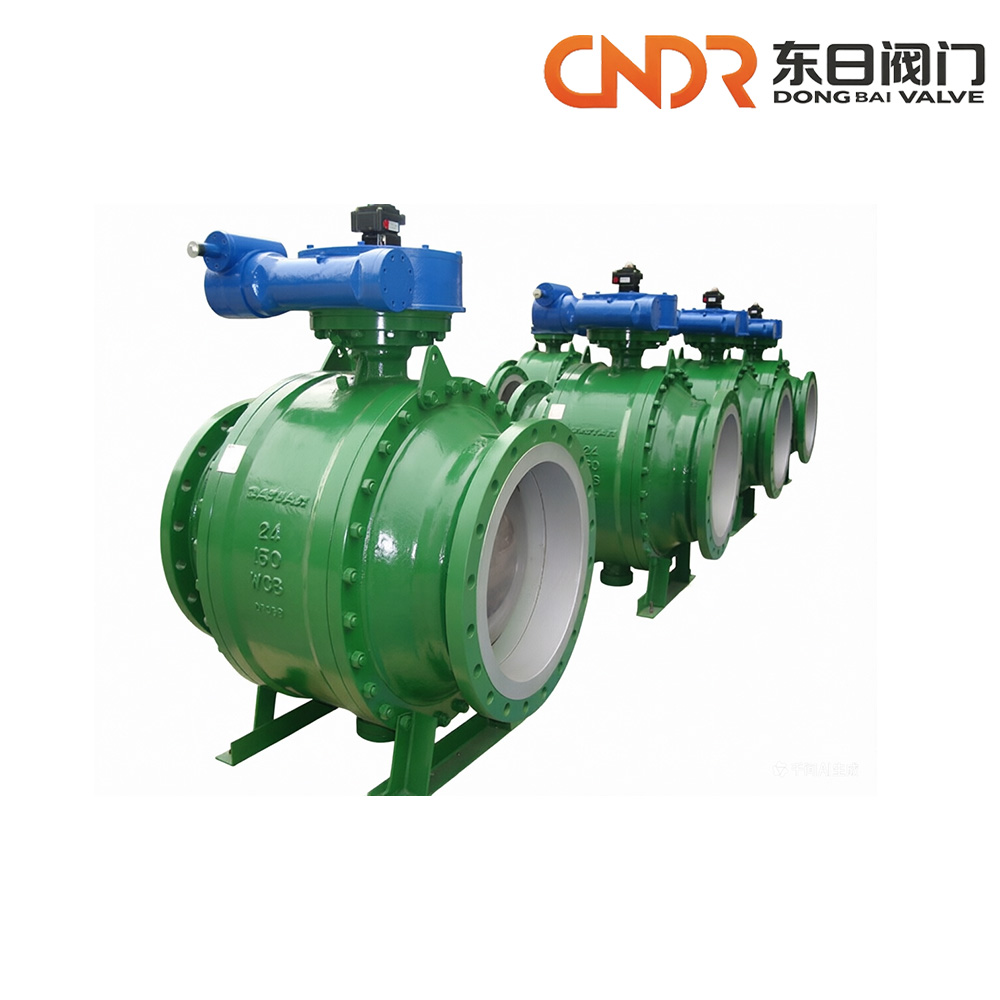
| Trunnion Mounted Ball Valve | The large-bore answer for LNG mainline and loading arms; spring-loaded seats keep preload through shrinkage | Mandatory cavity relief, spring-assisted seats, LN2 functional test per BS 6364 |
| Forged steel ball valve | Excellent below 4 inch where casting is refused; only F304/F316 or 9% nickel grades belong at -196°C | Confirm impact-test temperature on the MTR, not the stamp |
| Metal hard sealed ball valve | Wrong category for deep cold — reserve it for high-temperature and abrasive duty | Soft seats (PCTFE/nylon) for cryogenic; hard seats for 400°C+ |
| API Ball Valve (6D) | API 6D defines the family and fire-safe tests, not a cryogenic envelope | Dual-spec: API 6D dimensions + ISO 28921-1 / BS 6364 cryogenic qualification |
Actuator sizing is where substituting warmer rated valve in cryogenic service risks a second, quieter failure. Break-to-open torque climbs roughly 25% at -30°C to -50°C versus ambient, and keeps rising into LN2 range; an actuator sized on the warm datasheet stalls on the first cold stroke. Dongri sizes every automated deep-cold valve on cold-tested torque — a floating ball valve bought on a trunnion's budget saves $300 on the valve and costs $2,000 on the wrong gearbox.
For buyers the qualification question is simple: does the supplier test at your temperature, or claim it? Zhejiang Dongri Valve Co., Ltd. — a Chinese cryogenic ball valve manufacturer operating its own China factory since 1996 — LN2-cycles its range from -46°C to -196°C, publishes the test record with each OEM/ODM order, and supports wholesale programs for LNG and air-separation projects.
✅ Bottom line: At -196°C the safe shortlist is a stainless floating ball valve, a spring-seated trunnion mounted ball valve, or a 9% nickel forged steel ball valve — each tested cold, not each "rated close enough."
Q: Why is a -100°C valve unsafe at -196°C if stainless steel "works at any temperature"? A: Only austenitic grades genuinely do. A valve rated -100°C is usually 3.5% nickel steel, whose impact testing stops at -101°C — asking why a valve rated for -100°C cannot be used at -196°C is really asking who tested the toughness, and at what temperature. Replace the nickel grade with F316 and a cold-tested seat package and the same line can be made safe; a paperwork substitution cannot.
Q: Can we buy a cheaper API ball valve from stock and re-rate it for LNG service? A: Re-rating without testing is marketing, not engineering. An API ball valve to API 6D has no cryogenic requirement in it — you need the ball valve re-manufactured to ISO 28921-1 / BS 6364: correct bonnet, cryogenic seats, and a liquid-nitrogen cycle test witnessed at the design temperature. Dongri quotes cryogenic configurations as OEM/ODM builds from the China factory, not as modified room-temperature stock.
Q: What documents prove a cryogenic ball valve can actually run at -196°C? A: Demand four: MTRs showing Charpy impact testing at or below design temperature, the ISO 28921-1 bonnet length record, the LN2 functional test report with cold seat-leak results, and the cavity-relief design confirmation. Ask any supplier to explain in writing how substituting warmer rated valve in cryogenic service risks is controlled for your line — silence is the answer.
Send your service temperature, medium and line size — Dongri's engineering team returns a matched ball valve design with its -196°C test record, or tells you plainly when a warmer substitute cannot be justified. Free OEM/ODM configuration and wholesale program quotes from our China factory.
Email: 241126365@qq.com
Mobile: +86 13777730323
Website:www.zjdrvalve.com
Email to this supplier
Privacy statement: Your privacy is very important to Us. Our company promises not to disclose your personal information to any external company with out your explicit permission.
Fill in more information so that we can get in touch with you faster
Privacy statement: Your privacy is very important to Us. Our company promises not to disclose your personal information to any external company with out your explicit permission.