


Please Leave Us A Message
Privacy statement: Your privacy is very important to Us. Our company promises not to disclose your personal information to any external company with out your explicit permission.
 Zhejiang Dongri Valve Co., Ltd.
A Ball Valve is almost always the right on/off isolation choice, but choosing the wrong sub-type — floating instead of trunnion mounted, cast instead of forged steel, or soft instead of metal hard sealed — quietly doubles your cost or fails the service. Zhejiang Dongri Valve Co., Ltd., a Chinese ball valve manufacturer and OEM/ODM supplier, builds all four designs to API 608 and API 6D.
Pick a Floating Ball Valve for small-bore, low-to-mid pressure isolation; pick a Trunnion Mounted Ball Valve the moment the line exceeds roughly 8 inch at Class 300 or needs double block and bleed.
A floating ball valve has a free ball pushed against the downstream seat by line pressure. Sealing improves as pressure rises — ideal for utility headers, instrument root Valves and general isolation up to Class 600. It is the default per API 608 and the cheapest option: a 6 inch Class 150 floating body weighs about 40 kg and costs a fraction of a trunnion unit. The catch is torque — above roughly 8–10 inch at Class 300, the force needed to seat the ball makes the actuator oversized and the seat overstressed.
A trunnion mounted ball valve anchors the ball on upper and lower bearings; spring-loaded seats press inward, so sealing force stays nearly constant regardless of line pressure. That unlocks sizes from 4 inch to 60 inch-plus and Class 150–2500, and — because both seats seal independently — true double block and bleed. Expect 2–4× the floating price and about 100 kg at 6 inch Class 150, offset by 30–50% smaller actuators at high pressure.
| Parameter | Floating Ball Valve | Trunnion Mounted Ball Valve |
| Ball support | Free-floating, no bearings | Fixed on trunnion bearings |
| Sealing force | Rises with line pressure | Spring-driven, near-constant |
| Practical limit | ~8–10″ at Class 300 | 4″ to 60″+, Class 150–2500 |
| Double block & bleed | No | Yes |
| Cavity relief | Not required | Required (API 6D) |
| 6″ Class 150 weight | ~40 kg | ~100 kg |
| Typical standard | API 608 | API 6D, API 608 |
| Cost | Baseline | 2–4× floating |
Dongri supplies both floating and trunnion mounted ball valves across DN15–DN1000, with trunnion units offered in side-entry and top-entry bodies for pipeline and EPC projects.
✅ Bottom line: Choose a floating ball valve below roughly 8 inch at Class 300; switch to a trunnion mounted ball valve for larger bore, higher class, or any double block and bleed requirement.
Specify a Forged Steel Ball Valve for small-bore high-pressure or sour duty, a Metal Hard Sealed Ball Valve for abrasive or high-temperature media, and confirm the API Ball Valve edition (608 vs 6D) before comparing quotes — each premium is earned only in specific service.
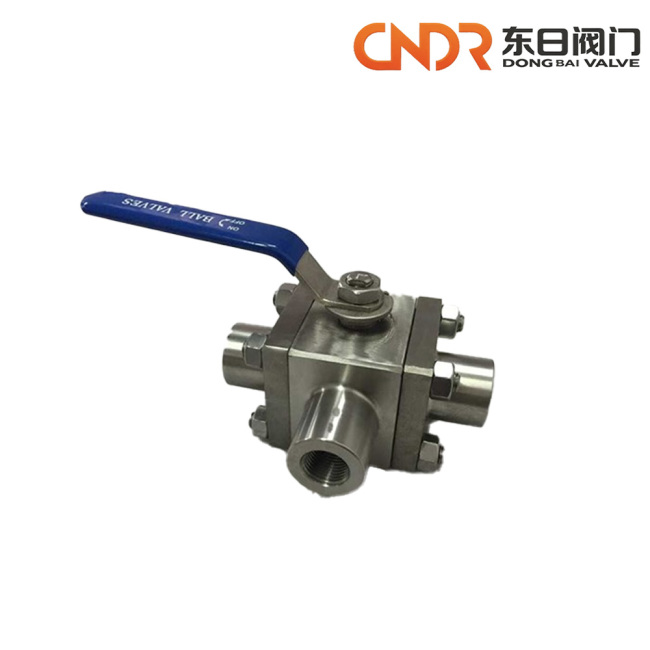
A forged steel ball valve starts from a solid billet shaped under compressive force, which refines the grain structure, removes porosity and lifts fatigue strength over a casting. Bodies in ASTM A105 carbon steel or A182 F304/F316 stainless cover 1/4 inch to 4 inch and Class 150–2500 plus Class 800, with threaded, socket-weld or butt-weld ends. It is the standard for instrument root valves, high-pressure gas (Class 600+) and NACE MR0175 sour service, where forged A105 hardness control is far more reliable than cast. The trade-off is 20–50% higher cost and a practical size ceiling around 4 inch — above that, casting wins on economics.
A metal hard sealed ball valve replaces soft PTFE seats with hard-faced metal ball-and-seat pairs for media that destroys polymers: superheated steam, slurry, catalyst fines and coking units. Hardfacing sets the temperature ceiling — Stellite (HRC 38–55, to ~800 °C), chromium carbide (to 815 °C) or tungsten carbide (to 400 °C, best abrasion). Precision lapping reaches API 598 / ISO 5208 shutoff Class V–VI, and the all-metal interface is fire-safe per API 607 by design. Dongri offers metal hard sealed ball valves in both floating and trunnion forms, with Stellite or tungsten-carbide coatings selected per your media.
An API ball valve is not one product — it is two standards with opposite risk profiles. API 608 covers process-facility ball valves (refineries, chemical plants, offshore platforms): ball valves only, full or reduced bore, DBB optional, fire testing optional, tested per ASME B16.34, sizes 1/2–36 inch. API 6D covers pipeline and piping valves: trunnion standard, full bore mandatory, DBB and cavity relief required, API 607 fire testing mandatory, low-pressure gas seat test (60–100 psig) required, sizes 2–60 inch-plus. The price gap is substantial, so never write "API compliant" without naming the edition.
| Requirement | API 608 (process) | API 6D (pipeline) |
| Scope | Refineries, plants, offshore | Pipelines, gathering, distribution |
| Valve types | Ball only | Ball, gate, check, plug |
| Bore | Full or reduced | Full bore mandatory |
| DBB | Optional | Required |
| Cavity relief | Not required | Required |
| Fire test (API 607) | Optional | Mandatory |
| Sizes | 1/2″–36″ | 2″–60″+ |
| Documentation | Standard QMS | MTR, NDE, witnessed |
✅ Bottom line: Forged steel earns its premium below 4 inch at high pressure or sour service; metal hard sealed survives abrasion and heat; and the API 608 vs API 6D choice is decided by whether the valve sits inside a plant or in a pipeline.
Q: What is the difference between a floating and a trunnion mounted ball valve? A: A floating ball valve lets line pressure push a free ball against the downstream seat — cheap and fine up to about 8 inch at Class 300. A trunnion mounted ball valve pins the ball on bearings with spring-loaded seats, enabling sizes to 60 inch, Class 2500 and true double block and bleed. Dongri builds both to API 608 and API 6D.
Q: When should I specify a metal hard sealed ball valve instead of a soft-seated one? A: Whenever the media is abrasive, slurry-laden, or above roughly 260 °C — superheated steam, coking units, mining slurry and hydrogen service. Hard-faced seats (Stellite, tungsten or chromium carbide) survive where PTFE fails, with fire-safe metal-to-metal backup sealing.
Q: Is a forged steel ball valve better than a cast one? A: For small bore (≤ 4 inch) at Class 600+ or sour service, yes — forging removes porosity and controls hardness for NACE compliance. A forged steel ball valve typically costs 20–50% more but lowers failure risk in critical duty.
Tell Dongri your media, size, pressure class and standard edition, and our engineering team will confirm whether a floating, trunnion mounted, forged steel or metal hard sealed ball valve fits — and quote API ball valve configurations to API 608 or API 6D from our China factory. Zhejiang Dongri Valve Co., Ltd. supports OEM/ODM and wholesale volumes for global EPC and distributor buyers.
Email: 241126365@qq.comMobile: +86 13777730323Website:www.zjdrvalve.com
Email to this supplier
Privacy statement: Your privacy is very important to Us. Our company promises not to disclose your personal information to any external company with out your explicit permission.
Fill in more information so that we can get in touch with you faster
Privacy statement: Your privacy is very important to Us. Our company promises not to disclose your personal information to any external company with out your explicit permission.