


Please Leave Us A Message
Privacy statement: Your privacy is very important to Us. Our company promises not to disclose your personal information to any external company with out your explicit permission.
 Zhejiang Dongri Valve Co., Ltd.
A project manager signing off an LNG terminal Valve list is not buying one product — they are specifying a family of cryogenic Ball Valve for LNG terminal application specifications that behave completely differently at every node of the plant. The liquefaction train, the storage tanks, the ship loader and the send-out regasification line each impose a distinct duty: a different temperature floor, a different pressure class, and a different seat and bonnet requirement. Treat them as one generic "LNG valve" and you collect leakage calls during commissioning.
This duty map walks the asset from liquefaction to send-out and pins the right ball valve to each stage, so the bill of materials reads like engineering rather than guesswork.
LNG is stored and moved at roughly −162°C, but the equipment around it sees a much wider band. The mixed-refrigerant liquefaction loop runs propane at about −40°C, ethylene near −100°C and methane close to −160°C; storage and ship loading sit at −162°C; the send-out regasification train warms gas from −162°C back to ambient. Each step is a separate cryogenic duty, and the LNG value chain valve duty from liquefaction to send-out shifts with it. A valve qualified only to −46°C on the propane loop is not the same animal as a −196°C trunnion on the tank bottom.
That is why cryogenic valve selection by LNG value chain stage must start from the node, not the fluid. The fluid is always "cold," but the node decides the test temperature, the bonnet length (per ISO 28921-1) and the seat material. A coherent cryogenic ball valve for LNG terminal application specifications package is therefore a stack of stage-matched Valves, not a single part number.
1. Liquefaction refrigeration loops (−40°C to −160°C). The mixed-refrigerant train uses multiple small- and mid-bore valves on the propane, ethylene and methane circuits. Here a Floating Ball Valve in CF8M or F316 handles the lower-pressure loops, while higher-pressure refrigerant stages call for a Trunnion Mounted Ball Valve with spring-assisted seats to hold preload through thermal shrink. API 608 bodies with extended bonnets cover the −40°C to −100°C legs; the −160°C methane circuit needs full −196°C qualification.
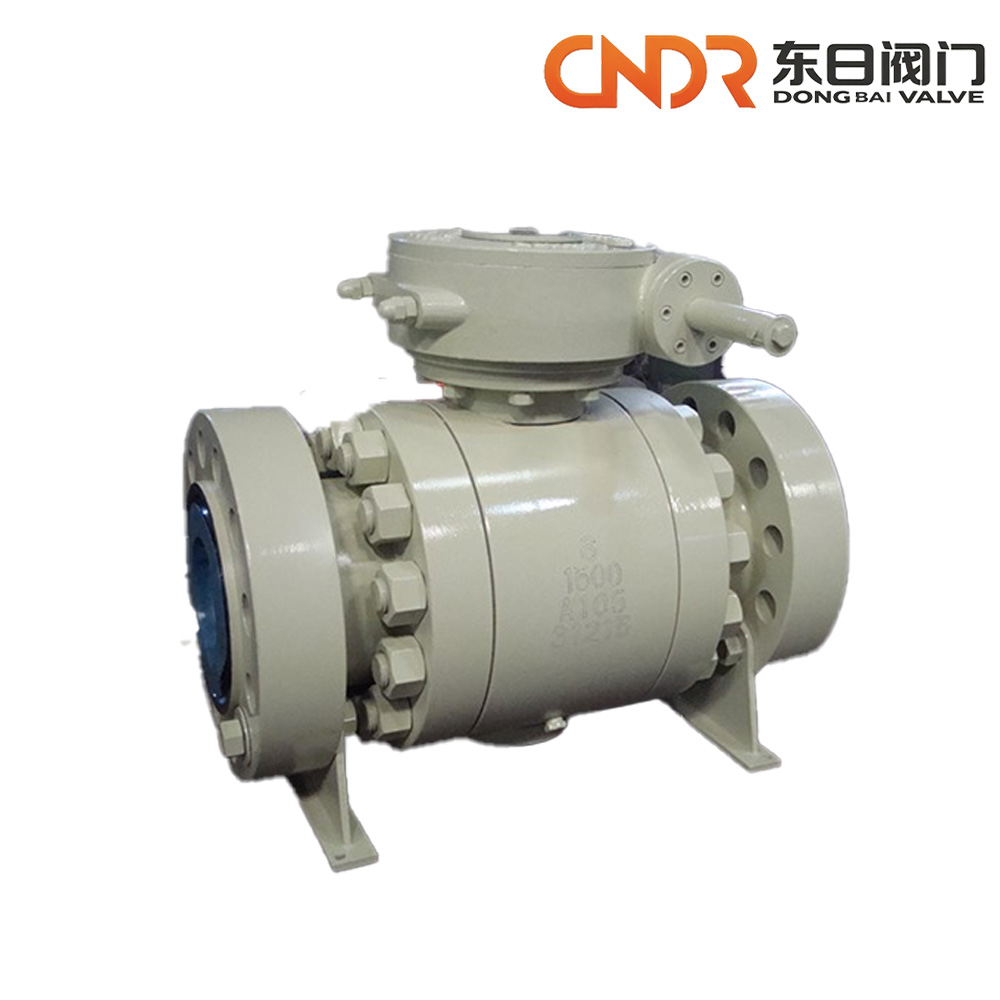
2. LNG storage tanks (−162°C, near-atmospheric). Tank bottom, boil-off gas (BOG) and line-up valves carry the full −162°C / −196°C duty at low pressure. Full-bore trunnion mounted ball valve bodies dominate — fire-safe, double-block-and-bleed, with PCTFE or RPTFE seats and a 500 mm bonnet per ISO 28921-1. This is where a plain API Ball Valve to API 6D proves fire behavior at ambient but still needs the separate cryogenic dossier.
3. Ship loading and truck loading (−162°C, higher pressure). Loading arms and manifolds run −162°C at elevated pressure, so a Forged Steel Ball Valve in F316 is common for wall integrity and fatigue resistance. Forged bodies do not add cold tolerance over cast CF8M at the same chemistry, but they earn their place on high-cycle loading lines where porosity would bite.
4. Send-out and regasification (−162°C to ambient). The cold side of the send-out line — before the vaporizer — is full cryogenic duty and uses the same trunnion/PCTFE spec as storage. The warm side, after regas, is a normal-temperature gas valve and should not be over-specified as cryogenic. A Metal Hard Sealed Ball Valve earns its keep on the BOG recycle and any abrasive or repeated-cycling line where soft seats would fatigue.
A stainless body with the wrong seat leaks while still "correct" on the spec sheet. For LNG the seat chemistry — PCTFE or RPTFE — holds preload through shrinkage and survives LN2 seat-leak tests; metal seats extend life on cycling BOG lines. The forged steel ball valve route is bought for high-pressure integrity, not extra cold rating; the Charpy floor follows chemistry, not process.
Standards split cleanly: API 608 / API 6D govern the API ball valve fire-safe and stem-retention behavior at ambient, while ISO 28921-1 and BS 6364 govern the cryogenic qualification with cold cycle and seat-leak tests. A correct cryogenic ball valve for LNG terminal application specifications list dual-references both, because comparing API fire-safe to ISO cryogenic is comparing apples to pears. Reading the LNG value chain valve duty from liquefaction to send-out stage by stage keeps the standard stack honest.
Q1: Can one cryogenic valve type cover the whole terminal? Downward compatibility mostly holds — a −196°C valve runs fine warmer — but the economics and bonnet size do not. A −46°C propane-loop valve should never carry a 500 mm bonnet or a cryogenic price tag, and a tank-bottom trunnion is oversized for a chilled-water run. Cryogenic valve selection by LNG value chain stage keeps each node correctly sized and priced, which is exactly what a clean cryogenic ball valve for LNG terminal application specifications set achieves.
Q2: Why do some lines spec a metal-seated valve in an all-LNG plant? LNG itself is clean, but boil-off gas recycle, flash lines and frequent-cycling send-out duty fatigue soft seats. A metal hard sealed ball valve resists wear and keeps a tight shutoff where the duty is cyclic, while the main LNG storage and loading lines stay on PCTFE for bubble-tight cold performance.
Which standard proves an LNG valve is safe? No single standard covers both. API 6D / API 607 prove fire-safe and stem retention at ambient; ISO 28921-1 and BS 6364 prove the cryogenic cycle, seat-leak and bonnet performance at −196°C. Specify both on the tender so the LNG value chain valve duty from liquefaction to send-out is documented at every node.
Do forged bodies survive colder than cast bodies? No. Forging refines grain and closes porosity for high-pressure integrity, but the Charpy impact floor follows alloy chemistry, not process. A forged steel ball valve in F316 reaches the same −196°C as cast CF8M; buy forging for pressure and cycle life, not temperature.
How many bonnet lengths exist for cryogenic service? ISO 28921-1 defines extension classes (commonly 150 / 250 / 350 / 500 mm) tied to valve size and temperature, keeping the stem packing above the cold zone. Tank and send-out duties at −162°C typically use the longest class, while propane-loop valves need far less.
Zhejiang Dongri Valve Co., Ltd. has built valves in its own China factory since 1996. Dongri supplies project managers with the full cryogenic range — CF8M, 9% nickel and F316 bodies, floating ball valve, trunnion mounted ball valve and forged steel ball valve configurations, PCTFE or metal seats, ISO 28921 bonnets and witnessed cold tests. Dongri documents every node with dual-certified reports. As a direct manufacturer and supplier, Zhejiang Dongri Valve Co., Ltd. supports OEM/ODM builds and wholesale program pricing for LNG repeat orders, and handles OEM/ODM customization from its China factory.
Map your terminal by stage, then talk to Dongri about a duty-matched cryogenic ball valve for LNG terminal application specifications package — and get a bill of materials that reads like engineering, not a gamble, with every ball valve duty-matched to its node.
Email: 241126365@qq.com
Mobile: +86 13777730323
Website:www.zjdrvalve.com
Email to this supplier
Privacy statement: Your privacy is very important to Us. Our company promises not to disclose your personal information to any external company with out your explicit permission.
Fill in more information so that we can get in touch with you faster
Privacy statement: Your privacy is very important to Us. Our company promises not to disclose your personal information to any external company with out your explicit permission.