


Please Leave Us A Message
Privacy statement: Your privacy is very important to Us. Our company promises not to disclose your personal information to any external company with out your explicit permission.
 Zhejiang Dongri Valve Co., Ltd.
Every engineer specifying Valves for cold service eventually hits the same warning on a datasheet: carbon steel body, minimum temperature -29°C. The question why carbon steel Ball Valve becomes brittle below -29°C is not a vendor preference — it is the ductile-to-brittle transition, a real physical cliff in the metal that turns a normally tough material into one that can shatter without warning.
This article explains the transition, the codes behind the -29°C wall, and what to specify instead when the service goes colder.
Steel does not lose strength uniformly as it cools. Above a certain temperature it fails in a ductile way — it stretches, necks and absorbs energy before breaking. Below that point it can fail by cleavage: a fast, low-energy crack that runs through the part with almost no plastic deformation. The temperature where this switch happens is the ductile to brittle transition temperature for Valve body materials, measured with Charpy V-notch impact testing. A material that passes at +20°C can drop to near-zero toughness at -40°C, which is exactly why a warm-climate spec cannot simply be reused in a cold duty.
The -29°C (-20°F) limit is not arbitrary. ASME B31.3 and the pressure-equipment codes treat unqualified carbon steel as usable only down to that temperature; below it the material must be impact-tested to prove its transition sits beneath the design minimum. A standard API Ball Valve body in ASTM A216 WCB is therefore stamped with an MDMT (minimum design metal temperature) of -29°C unless a separate Charpy qualification is supplied. Specifying past that line without the test is specifying a part the code does not endorse.
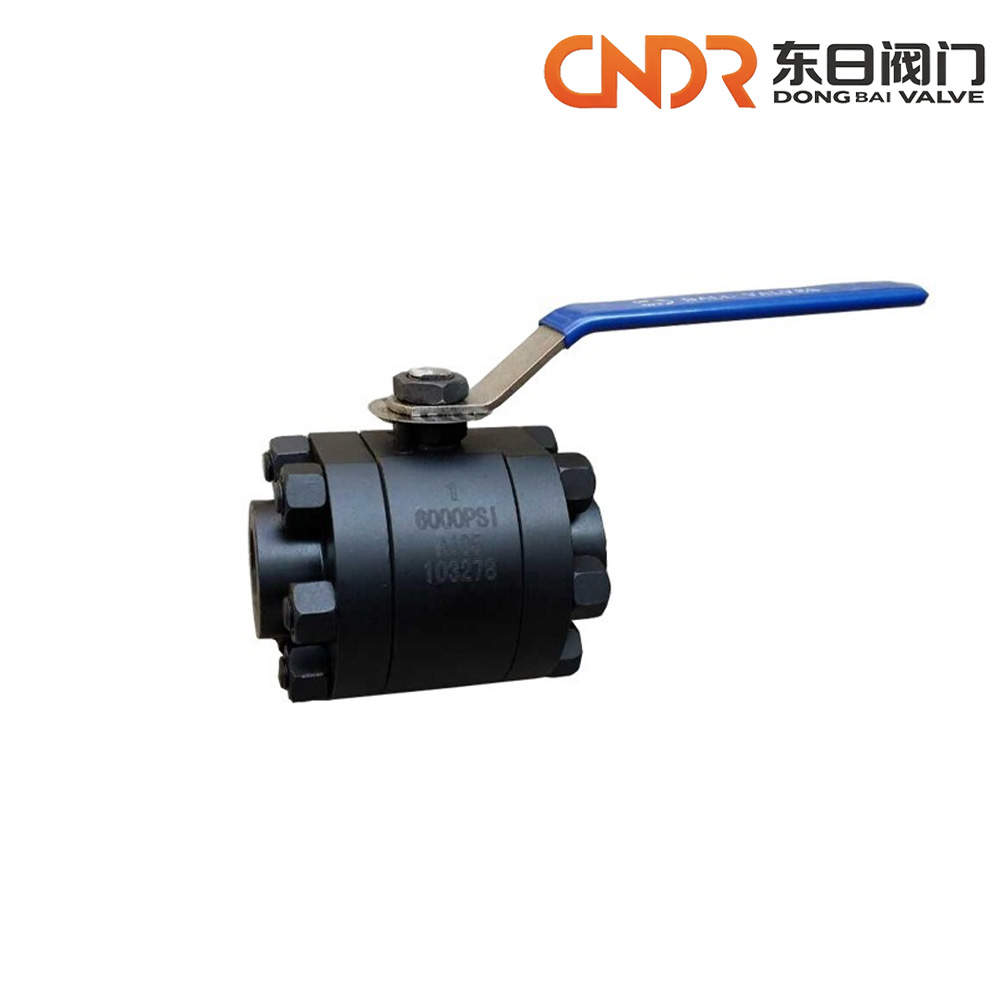
The WCB carbon steel not allowed in cryogenic service reason is the transition itself. WCB is a cast carbon steel with no low-temperature alloying, so its Charpy toughness collapses well above the cryogenic band. Even when impact-tested, plain WCB rarely qualifies below about -46°C, and it certainly never reaches the -101°C or -196°C duties of ethylene or LNG. The WCB carbon steel not allowed in cryogenic service reason is therefore structural, not administrative: the body would be at risk of brittle fracture exactly when the plant needs it most. A Forged Steel Ball Valve in A105 carbon steel shares the same wall — forging refines grain but does not move the transition, so the -29°C rule applies to forged carbon steel too.
Once the duty drops below -29°C, the body alloy must climb the low-temperature ladder:
The ductile to brittle transition temperature for valve body materials is the single number that decides where on this ladder a valve must sit.
A correct cold valve is more than a qualified body. The seat material — PCTFE or RPTFE — holds preload through thermal shrink and survives liquid-nitrogen seat-leak tests, while a Metal Hard Sealed Ball Valve earns its place on cycling or erosive lines where soft seats would fatigue. The bonnet needs the ISO 28921-1 extension so the stem packing stays above the cold zone on every ball valve in cold service, and a metal hard sealed ball valve is the right call for repeated thermal cycling where soft seats would crack. Standards separate cleanly: an API ball valve to API 608 or 6D proves fire-safe and stem retention at ambient, while ISO 28921-1 and BS 6364 prove the cryogenic cycle and seat-leak at temperature. Large-bore main lines run a Trunnion Mounted Ball Valve for stem-load margin; small utility runs use a Floating Ball Valve; high-pressure drains use a forged steel ball valve — but always in a low-temperature-qualified alloy, never plain carbon steel.
Q1: If I impact-test WCB, can it go cryogenic? Marginally, and only with documented Charpy proof at the design temperature — but the practical floor stays near -46°C, far above true cryogenic duty. The why carbon steel ball valve becomes brittle below -29°C risk does not disappear with a single test; it just gets bounded. For LNG or LIN service, step up to LCB, 9Ni or stainless instead.
Q2: Does forging let carbon steel beat the -29°C limit? No. Forging improves grain and closes porosity for pressure integrity, but the transition temperature follows chemistry, not process. An A105 forged steel ball valve and an A216 WCB casting share the same -29°C wall; only a low-temperature alloy grade moves the line.
What exactly is the -29°C rule for carbon steel? It is the default minimum temperature for unqualified carbon-steel pressure parts under ASME B31.3 and related codes. Below it, the material must be Charpy impact-tested and the MDMT documented, or a low-temperature grade must be used.
How low can LCB/LCC carbon steel go? Impact-tested A352 LCB/LCC typically qualifies to about -46°C. That covers chilled-water and some refrigeration duties, but not ethylene (-101°C) or LNG (-162°C), which need nickel steels or stainless.
Why is stainless used for deep cryogenic service? Austenitic stainless (CF8M / F316) has a face-centered cubic structure with no ductile-to-brittle transition, so its toughness holds from ambient down to -196°C and below, making it the safe default for LNG, LIN and LOX valves.
Zhejiang Dongri Valve Co., Ltd. has built valves in its own China factory since 1996. Dongri supplies cold-service projects with bodies qualified to the right floor — LCB, 3.5% nickel, 9% nickel and CF8M / F316, in floating ball valve, trunnion mounted ball valve and forged steel ball valve configurations with PCTFE or metal seats, ISO 28921 bonnets and witnessed cold tests. Dongri documents every body with dual-certified reports. As a direct manufacturer and supplier, Zhejiang Dongri Valve Co., Ltd. handles OEM/ODM customization and wholesale program pricing for repeat orders, and runs OEM/ODM batches from its China factory with full API and cryogenic dual documentation.
Send Dongri your MDMT and duty, and get a body ladder that respects the ductile to brittle transition temperature for valve body materials — so the why carbon steel ball valve becomes brittle below -29°C rule never becomes a field failure.
Email: 241126365@qq.com
Mobile: +86 13777730323
Website:www.zjdrvalve.com
Email to this supplier
Privacy statement: Your privacy is very important to Us. Our company promises not to disclose your personal information to any external company with out your explicit permission.
Fill in more information so that we can get in touch with you faster
Privacy statement: Your privacy is very important to Us. Our company promises not to disclose your personal information to any external company with out your explicit permission.